
Skip to content
The crown of a healthy tree

Tree irrigation using treated rainwater

High levels of land sealing, heavy rainfall and heatwaves mean that there is a growing desire and demand for more green spaces in towns and cities. However, tree irrigation will become more and more difficult due to the climate change. This makes it all the more important to take a forward-looking approach to new construction or regeneration projects and to take into account the conditions that will prevail over the coming decades — including for urban trees.

Have you thought about the trees?

Thorin Oesterle - tree-expert at HAURATON

We incorporate tree pits into the overall rainwater management plan. It is important to make good use of rainwater – to ensure healthy urban greenery all year round.

The growing importance of blue-green infrastructure

The impacts of climate change must be taken into account in construction. Construction is an investment spanning decades, and so the local effects of these changes – such as heavy rainfall events – must also be considered.
Flood protection is the top priority. At the same time, the question arises as to what solutions exist for distributing water resources during periods of drought. In the debate surrounding this growing challenge, the principle of the sponge city is frequently mentioned.

Urban trees help to mitigate the effects of climate change. This will significantly increase their importance in the coming years. It is therefore important to integrate tree pits as plantable retention spaces into the rainwater management concept right from the planning stage of new urban developments or urban regeneration projects. Only in this way can sustainable and healthy urban greenery be guaranteed.

Tree irrigation with treated rainwater from traffic areas/h2>

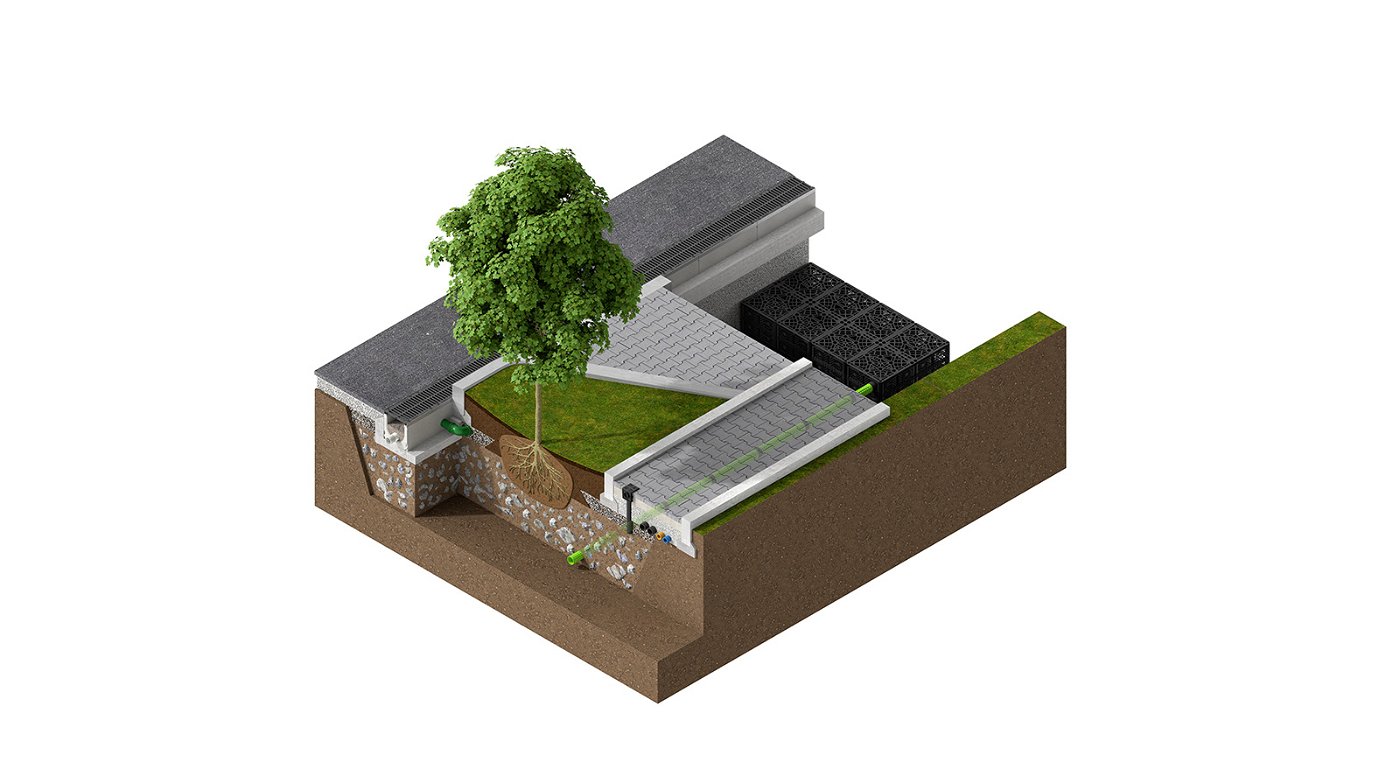
Tree pits with a filter substrate channel and a drainage unit (Option A)

This system ensures sustainable irrigation of tree pits. It consists of the DRAINFIX CLEAN filter substrate channel, which collects and filters rainwater and directs part of the purified water to the plantable retention area. The remaining water is channelled into the DRAINFIX BLOC infiltration unit, where it can seep away. This saves precious drinking water. The concept is ideal for tree-lined avenues and confined spaces.

  • A comprehensive system solution for draining, treating, retaining and infiltrating or irrigating trees
  • Rainwater treatment based on the principle of surface filtration, which also retains very fine particles (TSS63)
  • Extremely long maintenance intervals of up to 40 years
  • A large retention capacity provides protection during heavy rainfall and helps prevent flooding
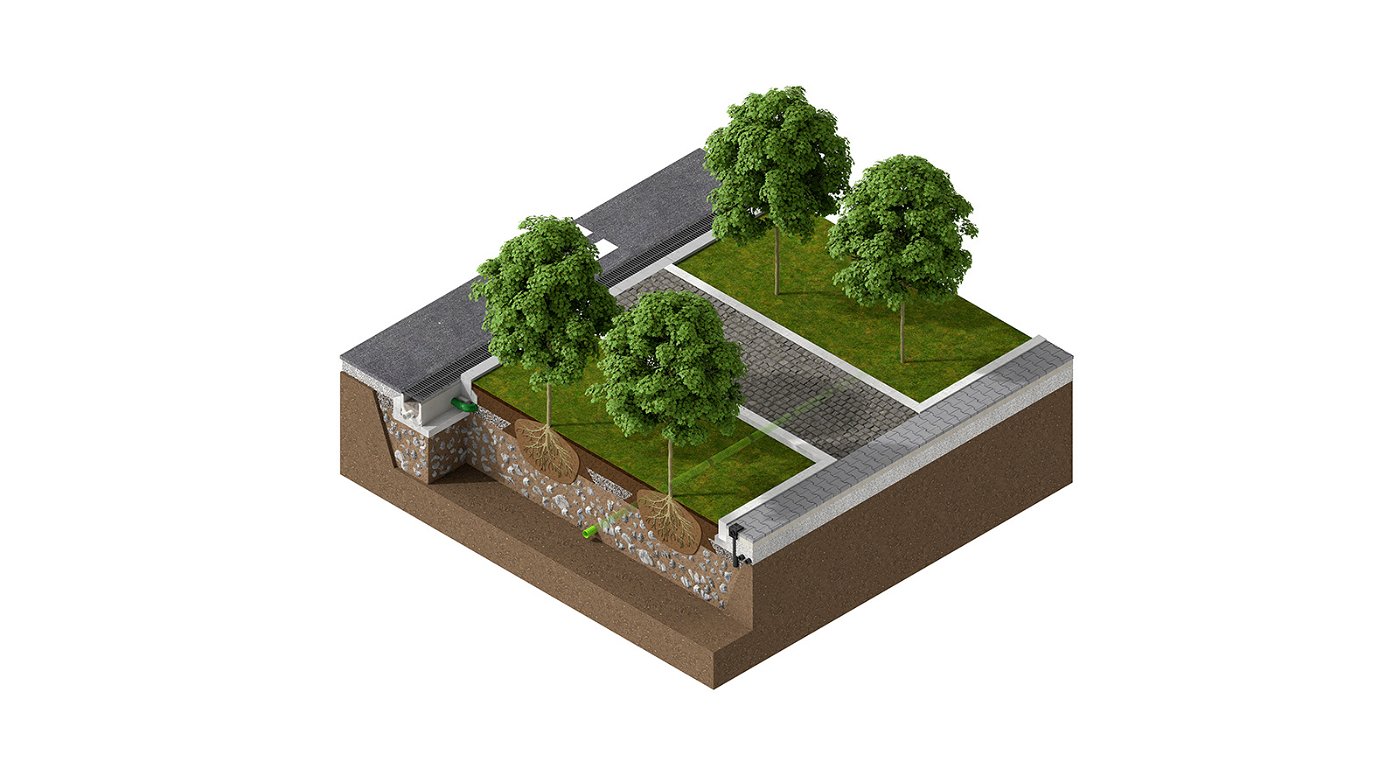
  • This option allows for the direct watering of several green spaces using treated rainwater from the filter substrate channel via a single system. The tree pit can be built over and used as a car park or footpath. The concept is suitable for green spaces with several trees.

  • Rainwater from traffic areas is collected and purified in DRAINFIX CLEAN filter substrate channels. The clean water flows directly into the tree pit or is diverted to a rainwater tank for temporary storage. Excess water seeps into DRAINFIX BLOC infiltration units and is thus returned to the natural cycle. In this way, rainwater can be retained and used for irrigation during dry periods – ensuring healthy urban greenery.

The following requirements for healthy urban trees must be observed:

Choosing the right tree species

When choosing a suitable tree species, the local climate, the soil and the desired appearance – such as the tree crown – are key factors.

There are also climate-resilient trees that can withstand extreme conditions for longer periods. A tree nursery will be happy to help you choose a suitable tree species.

Soil composition

Sufficient air and water capacity, along with a suitable pH level and a good supply of nutrients (humus content), are essential for ensuring that trees receive optimal nourishment via their root system.

Appropriate dimensions for the tree pit

Provided that the basic requirements – such as soil conditions, aeration and watering – are met, the planting hole should be roughly the same volume as the expected future crown of the tree. It is also important to ensure that the roots do not damage the road surface or underground pipes.

The correct procedure for planting

Incorrect handling during transport, temporary storage or unloading reduces the lifespan of street trees. Errors in the use of various support or anchoring systems for young trees can lead to damage to the bark, secondary damage caused by insects or fungi, and ultimately the death of these young trees.

A suitable irrigation plan

For proper irrigation of urban trees, it is important to take into account the tree species, the stage of development, climatic conditions, soil type and external factors such as road salt.

TREEPILOT

To assist with the irrigation of tree planting sites, HAURATON provides the digital tool TREEPILOT.

Go to the support page

The digital tool for planning: TREEPILOT helps you plan irrigation for tree sites – providing sound, transparent and practical guidance.

Direct to TREEPILOT

Launch TREEPILOT directly in your browser and calculate the dimensions of channels and tanks based on watering requirements in just a few steps.

Common methods for watering tree pits and their drawbacks

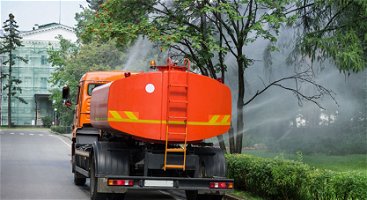
Mobile watering of tree pits with fresh water
Mobile irrigation

Temporary watering carried out by council staff incurs high costs (lorries, fuel, maintenance, staff wages). This raises the question of how much of the water actually reaches the roots through the dry soil. Furthermore, this method of watering generates unnecessary CO₂ emissions, noise and traffic disruption.

Why should rainwater be drained away, whilst drinking water is laboriously transported to the site and used for watering?

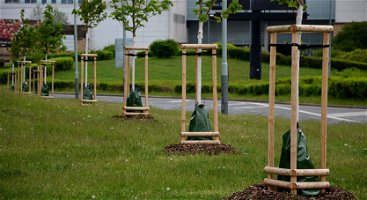
Tree watering bags
Tree watering bag

Tree watering bags can detract from the urban landscape. They are only suitable for small trees. Here, too, the question arises as to how much water actually reaches the roots efficiently. Furthermore: How is operational safety ensured? Who is responsible for ensuring that the bags contain neither too little nor too much water?

You might also be interested in:

Questions?

Our experienced planning team will be happy to help you.

Get in touch
Questions?