Challenges in heavy-duty rainwater management
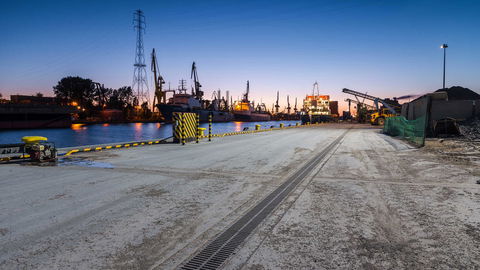
Every application in the heavy-duty sector – airports, industrial and logistics sites, as well as ports and container terminals – presents specific challenges for planners.
What do all heavy-duty areas have in common?
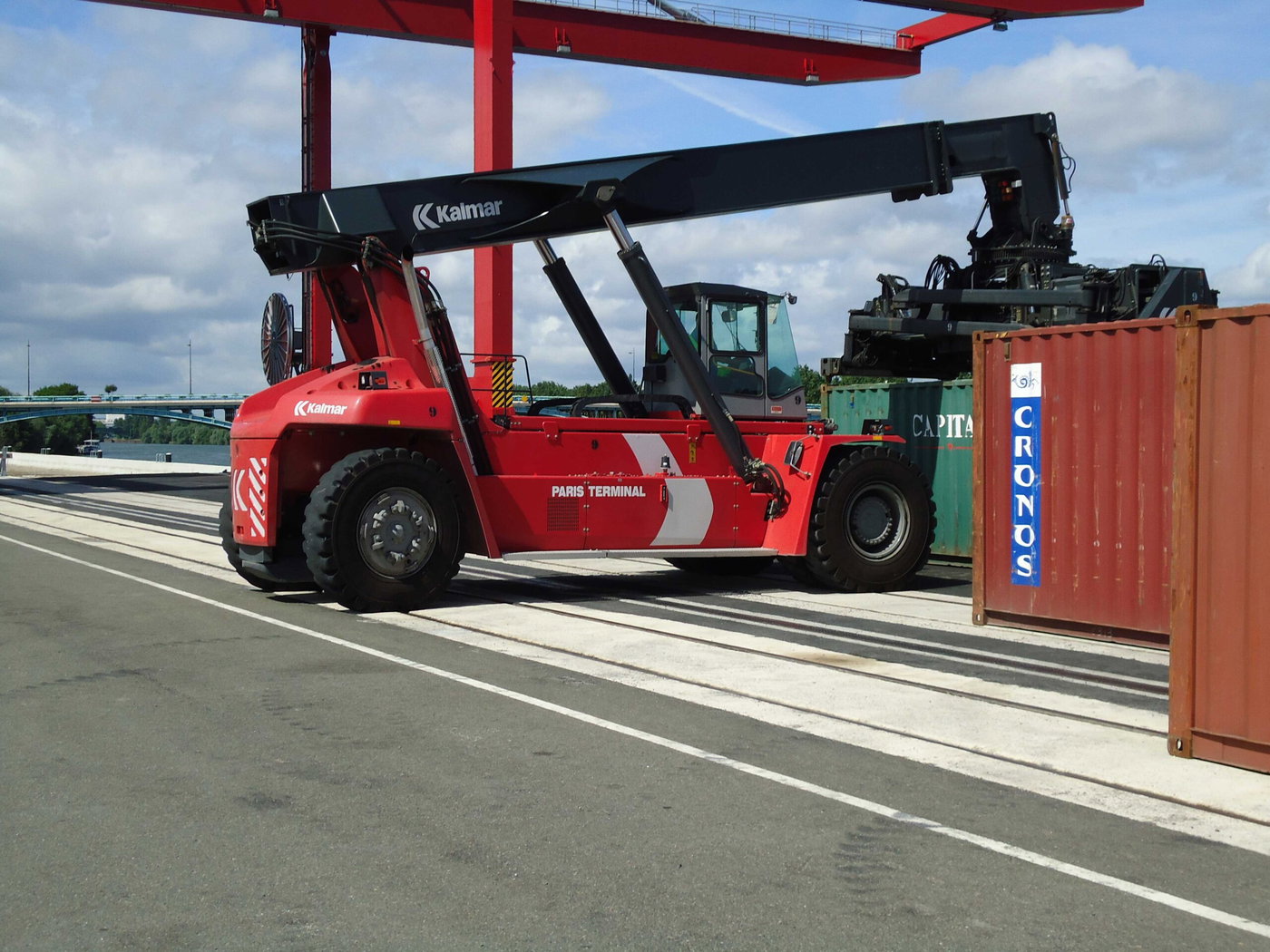
The safe movement of large and heavy vehicles, such as reach stackers or aircraft, must be guaranteed. This involves substantial loads caused by the dynamic movement of heavy-duty vehicles. At the same time, climate change is leading to increasingly frequent heavy rainfall events. High-performance heavy-duty drainage therefore plays a central role within a holistic rainwater management system. It is not just the rapid drainage of water that is crucial, but a coordinated interplay of collection, conveyance, treatment, retention and infiltration. This supports the natural water cycle.
Standards and regulations
Drainage channels are subject to European Standard EN 1433. For areas subject to particularly high wheel loads, heavy-duty channels of load class E 600 or F 900 are required. Where an airport is to be drained, further load-bearing capacity and serviceability assessments must be taken into account.
Environmental requirements increasingly stipulate not only the drainage of heavy-duty traffic areas but also the treatment of rainwater. Separate regulations exist for this purpose, which also provide recommendations for the use of infiltration and retention solutions.
The load-bearing capacity of infiltration and retention elements is often specified in SLW (heavy-duty vehicle). For example, SLW 30 stands for the corresponding total load of a 30-tonne lorry. This classification originates from a historical standard (DIN 1072), which has been replaced by EUROCODE 1 DIN EN 1991-2. Although there is no longer a classification by SLW in this standard, this specification remains widely used.
Consequences of improper rainwater management for heavy-duty traffic areas
If the rainwater management solution for a heavy-duty traffic area is not designed to meet the technical challenges and standards, this can lead to serious consequences:
- Material damage/deformation caused by incorrect load classes and materials
- Risk of injury from components coming loose
- Disruption to operations due to recurring repair work
- Environmental damage, such as contamination of groundwater, surface water or municipal sewer networks
What do rainwater management solutions for heavy-duty applications need to deliver?
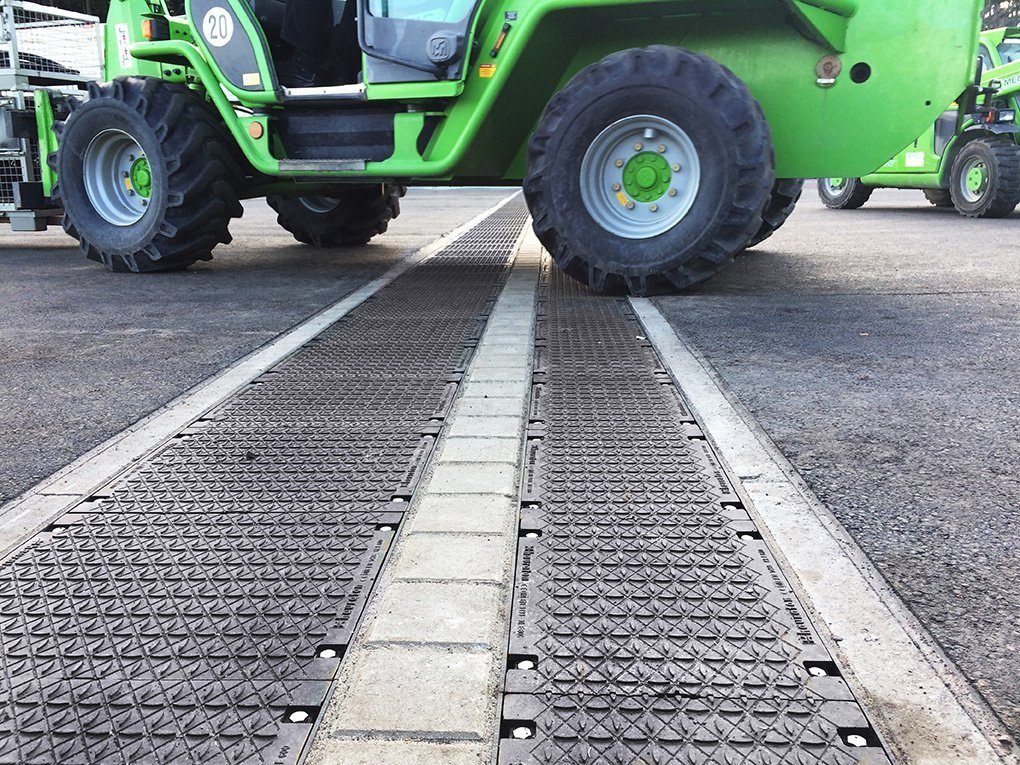
- Resistance to extreme loads and dynamic forces:
The materials and construction of the systems should be robust enough to withstand the high frequency and various forces caused by the vehicles’ braking, acceleration and rotational movements.
- High hydraulic capacity:
Drainage systems on large sealed surfaces must be able to quickly absorb particularly large volumes of water, store it reliably and channel it effectively, especially in the face of increasingly frequent heavy rainfall events.
- Reliable cleaning performance:
Surface runoff from heavy-duty areas is contaminated with microplastics, tyre wear and oil residues. If the rainwater is to be allowed to infiltrate on-site or used for other purposes, these pollutants must be reliably filtered out and retained.
- Large retention volume:
In order to use rainwater after it has been treated or to allow it to infiltrate, a sufficiently large storage capacity is required to safely store the water temporarily.
Comprehensive rainwater managements solutions for heavy-duty areas
Reliable drainage & load-bearing capacity
Heavy-duty surfaces are constantly exposed to high wheel loads from lorries and forklift trucks. At the same time, rainwater must be drained away quickly and efficiently, even during heavy rainfall, so as not to disrupt operational processes. This requires heavy-duty drainage systems with maximum hydraulic capacity.
Drainage system for areas subject to ultra-heavy duty areas
|
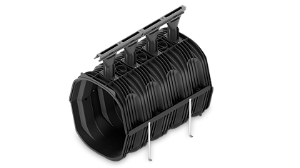
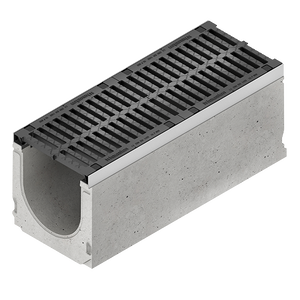
High capacity slot channel for areas subject to extreme loads & dynamic forces.
|
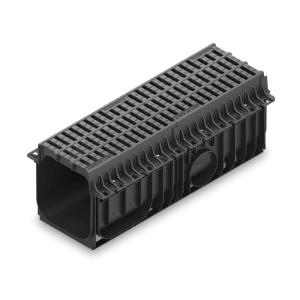
Monolithic drainage channel for heavy-duty applications
|
|---|
| Attribute | FASERFIX SUPER | RECYFIX HICAP F | RECYFIX MONOTEC ULTRA |
|---|---|---|---|
| Load class according to EN 1433 | Load class according to EN 1433: up to F 900 | Load class according to EN 1433: up to F 900 | Load class according to EN 1433: up to F 900 |
| Load frequency | Load frequency: 4 out of 6 | Load frequency: 6 out of 6 | Load frequency: 5 out of 6 |
| Load dynamics | Load dynamics: 4 out of 6 | Load dynamics: 6 out of 6 | Load dynamics: 6 out of 6 |
| Nominal width | System size | Nominal width | System size: 100, 150, 200, 300, 400, 500 | Nominal width | System size: 1000, 2000, 3000, 5000, 8000, 10000 | Nominal width | System size: 200, 300 |
| Materials of the lower parts | Materials of the lower parts: Fibre-reinforced concrete | Materials of the lower parts: Modified polypropylene (PP), approx. 93% recycled composite | Materials of the lower parts: Modified polypropylene (PP), approx. 93% recycled composite |
| Angle housing |
Angle housing: Galvanised steel or ductile iron edge rail with 40 x 40 mm insertion depth |
Angle housing: – |
Angle housing: – |
| Grating variants |
Grating variants: – Ductile iron gratings |
Grating variants: Retained ductile iron slotted top |
Grating variants: Ductile iron grating with lateral concrete anchoring |
| Gradient |
Gradient: – Constant depth |
Gradient: – Constant depth |
Gradient: – Stepped fall (at NW 200) |
| Special characteristics |
Special characteristics: – SIDE-LOCK, boltless locking system |
Special characteristics: – Radial installations possible |
Special characteristics: – Material combination of recycled PP and ductile iron for adaptability on the construction site and robustness |
Treatment & Water Protection
On areas subject to heavy goods vehicle traffic, rainwater becomes contaminated by tyre wear, oils and fuels. Without treatment, these substances enter watercourses and the soil. Modern drainage systems therefore also perform a purification function and help ensure compliance with legal requirements such as the Water Resources Act (WHG) and DWA-A 102 for comprehensive rainwater management.

Filter substrate channel for effective treatment of polluted surface water.
|

up to E 600
|
|---|
| Attribute | DRAINFIX CLEAN FSU | DRAINFIX CLEAN RNC |
|---|---|---|
| Load class according to EN 1433 | Load class according to EN 1433: up to F 900 | Load class according to EN 1433: up to E 600 |
| Load frequency | Load frequency: 4 out of 6 | Load frequency: 3 out of 6 |
| Load dynamics | Load dynamics: 4 out of 6 | Load dynamics: 3 out of 6 |
| Nominal width | System size | Nominal width | System size: 200, 300, 400, 500 | Nominal width | System size: 300, 400 |
| Materials of the lower parts | Materials of the lower parts: Fibre-reinforced concrete | Materials of the lower parts: Modified polypropylene (PP), approx. 93% recycled composite |
| Angle housing |
Angle housing: Galvanised steel or ductile iron edge rail with 40 x 40 mm insertion depth |
Angle housing: Moulded as an integral part of the channel body |
| Substrate requirement (l/m) | Substrate requirement (l/m): 30 to 79 | Substrate requirement (l/m): 53 to 80 |
| Max. channel water level (cm) | Max. channel water level (cm): 11 to 33 | Max. channel water level (cm): 9 to 21 |
| Filter surface (m2/rm) | Filter surface (m2/rm): 0.2 to 0.47 | Filter surface (m2/rm): 0.30 to 0.4 |
| Special characteristics |
Special characteristics: – SIDE-LOCK, boltless locking system |
Special characteristics: – Low weight |
Infiltration & Reducing Pressure on the Drainage System
The infiltration of rainwater allows precipitation to be returned directly to the natural water cycle on site. Particularly on heavy-duty sites with large sealed areas, it offers a sustainable solution for reducing runoff volumes and alleviating the pressure on the drainage system in the long term.
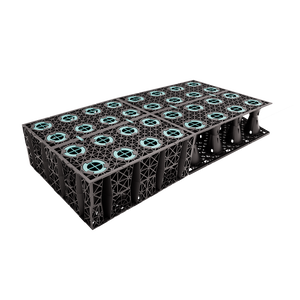
Dual-crate infiltration system for heavy loads on parking and logistics areas.
|
|---|
| Attribute | DRAINFIX BLOC HD |
|---|---|
| Load class according to EN 1433 | Load class according to EN 1433: up to SLW 40 |
| Load frequency | Load frequency: 4 out of 6 |
| Load dynamics | Load dynamics: 4 out of 6 |
| Storage volume | Storage volume: 383.2 litres |
| Dimensions (length/width/height) | Dimensions (length/width/height): 1m x 1m x 0.4m |
Controlled Retention & Runoff Management
Large areas of heavy-duty traffic generate high volumes of runoff during rainfall, which cannot be discharged into the sewer system unchecked. Retention systems temporarily store rainwater and release it at a controlled rate. This relieves pressure on sewer networks, reduces the risk of flooding and allows peak runoff to be managed effectively.
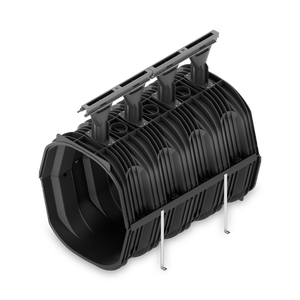
High capacity slot channel for areas subject to extreme loads & dynamic forces.
|
|---|
| Attribute | RECYFIX HICAP F |
|---|---|
| Load class according to EN 1433 | Load class according to EN 1433: up to F 900 |
| Load frequency | Load frequency: 6 out of 6 |
| Load dynamics | Load dynamics: 6 out of 6 |
| Nominal width | System size | Nominal width | System size: 1000, 2000, 3000, 5000, 8000, 10000 |
| Materials of the lower parts | Materials of the lower parts: Modified polypropylene (PP), approx. 93% recycled composite |
| Angle housing |
Angle housing: – |
| Grating variants |
Grating variants: Retained ductile iron slotted top |
| Gradient |
Gradient: – Constant depth |
| Special characteristics |
Special characteristics: – Radial installations possible |
Digitalisation & Use
Digital solutions enable the efficient control and monitoring of rainwater systems. At the same time, rainwater can be used as a resource, for example for washing vehicles or for irrigation. In this way, rainwater management becomes an integral part of sustainable land-use planning.
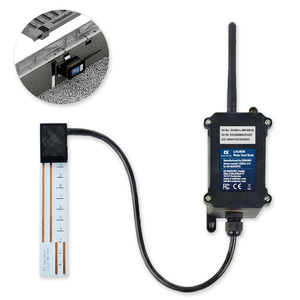
The DrainageGuard from RX-WATERTEC monitors the utilisation and performance of drainage channels
|
|---|
| Attribute | DrainageGuard |
|---|